
From fragmented information to intelligent decision-making
Having spent a significant part of my professional life in manufacturing and subsequently working on enterprise software for manufacturing companies, I have seen the same problem from two different sides.
Manufacturing companies have never really suffered from a lack of information. The problem has always been getting the right information together at the right time and understanding what it is telling us.
This is about to change.
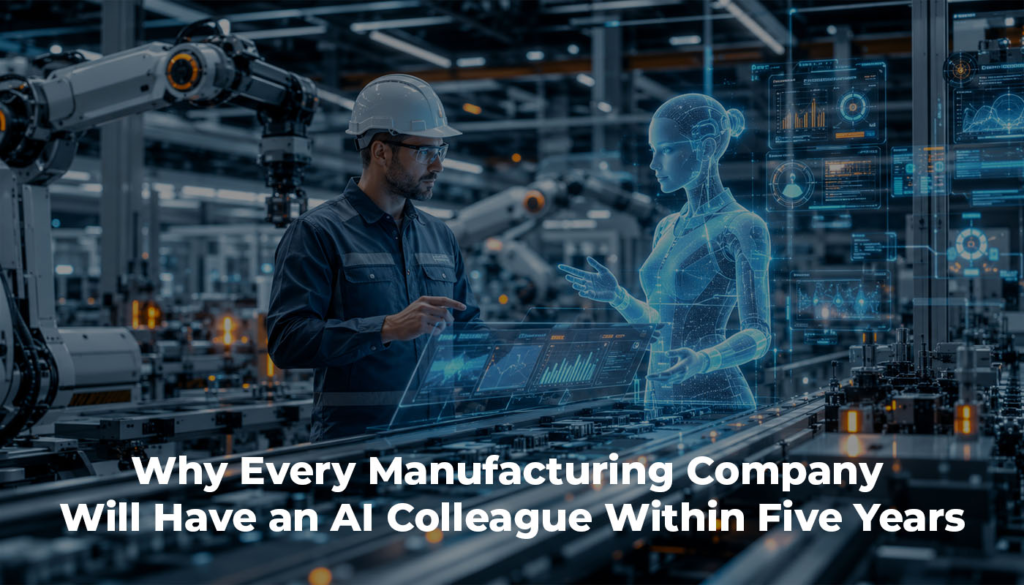
I believe that within the next five years, every manufacturing company will have what I would describe as an AI colleague—not a robot replacing people, and not another software package to be learned, but an intelligent system that can look across the company’s information and help people understand what is happening in the business.
The interesting part is that this does not necessarily require every company to first become completely digitised or implement one large integrated ERP.
That could be one of the biggest changes AI brings to manufacturing.
The reality of manufacturing IT
The traditional vision of digital manufacturing is an organisation where everything runs on an integrated ERP.
In practice, particularly among SMEs, the situation is often very different.
Accounting may be in Tally or another financial application. Sales and purchase may be managed through separate software. Production planning may still be in Excel. Quality records may be maintained in spreadsheets. Machine information may be available through a machine or maintenance system. Communication with customers, suppliers and subcontractors may happen through email or messaging applications.
There is nothing particularly unusual about this.
Businesses adopt technology incrementally. One system solves one problem; another is introduced when a new requirement appears. Over time, the organisation accumulates several systems.
Even mature manufacturing economies face this issue. ERP adoption in Europe remains strongly dependent on company size, and a digitally mature manufacturer can still have ERP, MES, CRM, machine data, quality systems and specialist applications operating alongside each other.
So the real issue is not simply whether a company has an ERP.
The real issue is whether the business can understand all the information it already has.
Consider a plant manager’s morning
Suppose a plant manager walks into the factory on Monday morning and asks:
“Which production orders require my attention today?”
Today, answering that question may involve looking at the production plan, checking material availability, reviewing machine capacity, looking at yesterday’s downtime, checking pending quality issues and perhaps speaking to supervisors.
An AI colleague could potentially bring these pieces together.
It might identify ten orders requiring attention and explain why:
1) Two are waiting for critical material,
2) Three are dependent on a machine with repeated downtime,
3) One has fallen behind because of low productivity,
4) Two have quality rework pending,
5) and another is at risk because its subcontracted operation has not returned on time.
The value is not that AI has produced another report.
The value is that it has connected the information and identified where management attention is required.
That is a fundamentally different role for enterprise software.
Inventory: beyond stock reports
Inventory systems traditionally tell us how much stock we have. The more useful question is:
“What does my inventory tell me about the future?”
An AI colleague could examine current stock, open purchase orders, production requirements, consumption patterns and delivery schedules and identify materials that are likely to become critical.
It could also identify the opposite problem:
“Which materials are tying up working capital without a corresponding requirement?”
For a manufacturing SME, that can be far more valuable than simply knowing the current stock value.
Production planning: understanding the risk
Production planning is another area where AI can make a significant difference.
A planner may know that an order is scheduled for delivery on Friday. But whether that order will actually be delivered depends on many variables—material availability, machine capacity, current load, downtime, process sequence, manpower and sometimes quality rework.
Instead of asking the planner to examine all these factors manually, management could ask:
“Which orders are likely to miss their committed dates, and what is causing the risk?”
The answer can be based on the actual situation on the shop floor rather than simply the planned schedule.
That distinction between plan and reality is where much of the value lies.
Machine downtime: from reporting to diagnosis
Most manufacturing companies already record machine downtime to some extent. The challenge is turning those records into useful knowledge.
An AI system could be asked:
“Which machines are losing the most productive hours?”
But the next question is more important:
“Why?”
Is the downtime concentrated on one machine? One shift? One type of failure? One product? One maintenance issue?
If a machine repeatedly loses productive hours for the same reason, the AI should be able to bring that pattern to the maintenance and production manager’s attention.
This moves maintenance analysis from simply recording downtime to understanding the pattern of downtime.
Workmen productivity: looking beyond the number
Productivity is another area where manufacturing organisations have large amounts of data but often limited analytical support.
A useful question is not simply:
“What was today’s productivity?”
It is:
“Where is productivity consistently below the expected level, and what could be causing it?”
The answer may reveal that a particular operation is taking longer than its standard time, that the problem occurs predominantly on one machine, that a particular product has higher cycle time, or that the issue is concentrated in a particular shift.
The purpose should not be to use AI as a surveillance mechanism for workers.
It should be to help management distinguish between problems related to people, process, machine, material or method.
That is much more useful for improving productivity.
Quality: finding patterns before they become problems
Quality management is perhaps one of the strongest applications of AI in manufacturing. A quality manager can ask:
“Where is rejection increasing?”
But AI can go further.
Is the increase associated with a particular material batch? A machine?
An operation? A product?
A shift?
A particular process parameter?
Has the same problem occurred previously?
Did the corrective action taken at that time actually reduce recurrence?
This is where AI can move quality management from reviewing historical reports towards identifying emerging patterns.
For an organisation working as a supplier to an OEM, this can be particularly important. A quality problem that is identified late can quickly become a delivery problem, a cost problem and ultimately a customer relationship problem.
Subcontracting: another information gap
Indian manufacturing has a large ecosystem of subcontractors and ancillary manufacturers.
Information about material sent for subcontracting, expected return dates, processing status, rejection and rework is often distributed across purchase records, production records and manual follow-up.
An AI colleague could answer:
“Which subcontracted jobs are currently putting our production schedule at risk?”
Or:
“Which subcontractors have shown increasing rejection or delays over the last three months?”
Again, the objective is not another report.
It is to identify the exceptions that deserve attention.
From “Ask your ERP” to “Ask your business”
We often use the expression “Ask Your ERP.”
I believe that is only partly correct.
If the information required to answer a question exists in an ERP, an accounting system, an MES, Excel, a quality application and machine data, then the manager is not really asking the ERP.
The manager is asking the business.
This is where AI has the potential to become an intelligence layer across the enterprise.
The underlying systems do not necessarily disappear. ERP remains important. MES remains important. Accounting systems remain important. Machine systems remain important.
What changes is the way people access the collective information.
Instead of learning where every piece of information resides, they can ask questions in the language of the business.
And the AI can determine what information is relevant.
But AI is not magic
There is an important qualification.
Connecting an AI model to several databases does not automatically make the system intelligent.
There has to be an underlying architecture that provides secure access to information, manages permissions, reconciles data from different systems and understands the relationships between business entities.
Most importantly, AI needs business context.
A machine is not simply a record in a database. It has a production role, capacity, history and maintenance context.
A production order is not just a number. It is connected to a customer requirement, material, routing, machine, operation, schedule and delivery commitment.
A quality rejection is not simply a quantity. Its significance depends on the product, process, specification and history.
This understanding of business semantics will, in my view, become one of the most important areas of enterprise AI.
AI will make data discipline more important
There is another consequence that manufacturers should recognise. AI will expose weaknesses in business data.
Duplicate item codes, inconsistent customer names, incorrect units, incomplete production records, different definitions between departments and business rules that exist only in people’s experience will all become obstacles.
Today, experienced employees compensate for many of these weaknesses because they know the business.
AI does not automatically have that knowledge.
Therefore, AI will not eliminate the importance of disciplined processes and reliable data.
It will make their importance much more visible.
This is actually a positive development.
It will encourage manufacturers to treat business data as an asset rather than simply something generated as a by-product of transactions.
The AI colleague will not replace the manager
I don’t see the most important question as:
“How many jobs will AI replace?”
I believe the more useful question for manufacturing leaders is:
“What will my people be able to accomplish when each of them has an intelligent colleague?”
A production manager can spend less time compiling reports. A quality manager can identify patterns earlier.
A maintenance manager can focus on recurring problems rather than manually searching downtime records.
A planner can see risks before the schedule is missed. And the business head can ask:
“What are the five things I should be concerned about today?”
The AI can provide the analysis.
The manager still makes the decision. That distinction is important.
The objective of AI in manufacturing should not be to remove human judgement. It should be to make human judgement better informed, faster and more consistent.
The next phase of manufacturing software
I believe we are entering a different phase of enterprise software.
For many years, our systems were primarily designed to record transactions. Then we built reporting systems to tell us what happened.
Analytics helped us understand why it happened. AI now gives us the possibility of asking:
What is happening? Why is it happening? What is likely to happen next? And where should I intervene?
For a manufacturing company, that could mean understanding inventory, production, machines, manpower, subcontractors, quality and finance as connected parts of the same business rather than as separate reports.
The starting point will be different for every company. Some will already have an integrated ERP.
Some will have several specialised systems. Some will still depend heavily on Excel.
But they can all move in the same direction.
Towards an enterprise where the knowledge of the business is available to the people who need it, when they need it, through a simple conversation.
That is why I believe every manufacturing company will have an AI colleague within the next five years. Not because AI will replace the systems and people we have today.
But because it will increasingly sit between those systems and the people who run the business—helping them see patterns, understand risks and make better decisions.
Tomorrow’s enterprise software will not just store data. It will understand the business.